
Why a Native German Voice Over Wins in the DACH Market

The Difference Between Voice Over, Dubbing and Localization
17/04/2026
Voice Over Script Writing: 7 Pro Tips That Make Recording Easier
09/05/2026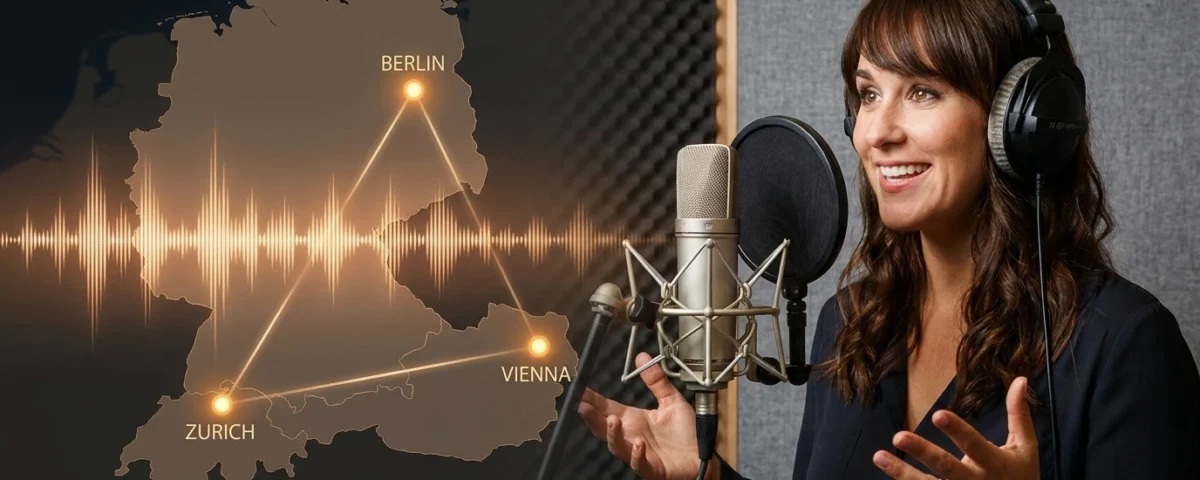
Your brand’s voice is one of the most powerful tools you have for building trust, creating emotional connections, and driving action. When that voice speaks German, the stakes are even higher. The DACH region — Germany, Austria, and Switzerland — represents one of the largest and most economically powerful markets in Europe, with over 100 million German speakers and a combined GDP that rivals major global economies. To reach this audience effectively, a native German voice over brand strategy is not a luxury — it is a necessity. In this article, I explain why native German voice over matters, what happens when brands get it wrong, and how to ensure your message truly resonates. If you want to hear what authentic German voice over sounds like, listen to my German voice over samples to get started.
First Impressions Are Auditory
Before your audience reads a single word of copy or evaluates your product, they hear your voice. In video advertising, e-learning, phone systems, and multimedia content, the voice over is often the very first point of contact between your brand and a potential customer. That first impression forms in seconds, and it is remarkably difficult to change.
Research consistently shows that people make subconscious judgments about trustworthiness, competence, and likability based on vocal quality alone. A voice that sounds natural, confident, and culturally familiar immediately puts the listener at ease. A voice that sounds foreign, stilted, or unnatural triggers skepticism — even if the words themselves are perfectly correct.
The Cost of Getting It Wrong
Brands that underestimate the importance of native voice over often learn the hard way. A non-native speaker may deliver grammatically accurate German, but the subtle markers of fluency — intonation patterns, stress placement, natural rhythm, and idiomatic expression — are almost impossible to fake. German listeners detect these inconsistencies instantly, even if they cannot articulate exactly what feels off.
The consequences are tangible. A commercial that sounds unnatural gets skipped. An e-learning module with awkward narration loses learner engagement. An IVR system with robotic or accented prompts frustrates callers and damages brand perception. In each case, the investment in video production, scripting, and distribution is undermined by a single weak link: the voice.
Consider the difference between a voice that says “Willkommen bei unserem Service” with native fluency and warmth versus one that technically pronounces every syllable but misses the natural melody of the sentence. The words are identical. The impact is worlds apart. To hear the difference for yourself, browse my voice over samples across different styles and formats.
Cultural Nuance Goes Beyond Words
Language is inseparable from culture. A native German voice over artist does not just speak the language — they understand the cultural context that shapes how words land. This includes knowing when formality is expected, when humor is appropriate, how to handle the distinction between Sie and du, and which references resonate with a German-speaking audience.
Cultural nuance extends to things that are difficult to codify in a script: the warmth in a greeting, the authority in a corporate narration, the playfulness in a commercial for a young audience. These qualities come from living and breathing the language, not from studying it.
German vs Austrian vs Swiss German
The German language is not monolithic. While standard German (Hochdeutsch) is understood throughout the DACH region, there are meaningful differences in vocabulary, pronunciation, and cultural tone between Germany, Austria, and Switzerland.
- German German (Bundesdeutsch): The standard for most international projects. Clean, widely understood, and culturally neutral across the region.
- Austrian German: Features distinct vocabulary (e.g., Paradeiser instead of Tomate, Jänner instead of Januar) and a softer, more melodic intonation. Important for projects specifically targeting the Austrian market.
- Swiss German (Schweizerdeutsch): The spoken dialect differs dramatically from written standard German. Swiss audiences may prefer Hochdeutsch for formal content but respond more warmly to Swiss-accented German in certain contexts.
Choosing the right variant signals respect for your audience. A pan-DACH campaign typically uses Hochdeutsch, while a campaign targeting Vienna specifically benefits from Austrian coloring. If you are unsure which variant your project needs, get in touch and I can help you decide based on your target market.

Trust and Credibility in the DACH Market
The DACH market is characterized by high consumer expectations around quality, precision, and authenticity. German-speaking audiences are discerning — they notice when content feels imported rather than created for them. This is especially true in sectors where trust is paramount: finance, healthcare, technology, and professional services.
A native German voice over communicates that your brand takes the market seriously. It says you have invested in doing things properly, not just cheaply. In a region where engineering excellence and attention to detail are cultural values, this matters more than you might expect.
The DACH Market by the Numbers
To appreciate the scale of opportunity — and the importance of getting your voice right — consider the economic significance of the DACH region:
- Population: Over 100 million people across Germany (84 million), Austria (9 million), and Switzerland (9 million).
- Economic output: Germany alone is the fourth-largest economy in the world and the largest in Europe.
- Digital adoption: High internet penetration and strong e-commerce activity make the DACH region a prime market for digital content, online advertising, and multimedia campaigns.
- Media consumption: German audiences consume substantial amounts of video content, with streaming platforms, YouTube, and social media driving demand for German-language audio.
These numbers represent real people making real purchasing decisions — people who respond to content that speaks to them in their own language, with their own cultural sensibility. Reaching them effectively starts with the voice. You can read what my clients say about the impact of professional native German voice over on their campaigns.
Consistency Across Touchpoints
Your brand voice should be consistent everywhere your audience encounters it — from television commercials and YouTube pre-rolls to e-learning platforms and telephone hold messages. Inconsistency creates confusion and erodes the brand identity you have worked to build.
Using a single native German voice over artist across all your German-language content creates a cohesive audio identity. Your audience begins to associate that voice with your brand, building familiarity and trust over time. This is the same principle that drives visual brand consistency: just as you would not change your logo from one campaign to the next, you should not change your voice without good reason.
Signs Your Voice Over Is Not Connecting
Sometimes the signs that your current voice over is not working are obvious. Other times, they are subtle but measurable. Watch for these indicators:
- High skip rates on video ads: If German-speaking viewers are skipping your ads more often than in other markets, the voice may be a factor.
- Low completion rates on e-learning modules: Learners disengage when narration feels unnatural or difficult to follow.
- Negative feedback on phone systems: Customer complaints about automated prompts often point to voice quality issues.
- Poor conversion on localized landing pages: If the page includes an embedded video with voice over, an unconvincing voice can drag down conversion rates.
- Inconsistent brand perception across markets: If your brand feels polished in English but amateur in German, the voice is likely part of the problem.
If any of these sound familiar, it may be time to invest in a professional native German voice over. Request a free quote to explore what upgrading your German audio would involve.
Beyond Translation — True Adaptation
A script that works brilliantly in English does not automatically work in German, even with a perfect translation. Sentence structures differ. Word lengths differ — German words are often significantly longer than their English equivalents, which affects timing and pacing. Humor, idioms, and cultural references may not transfer at all.
True adaptation means reworking the script so it sounds like it was originally written in German. A native voice over artist is an essential partner in this process because they can identify lines that feel unnatural, suggest more idiomatic alternatives, and deliver the final recording with the rhythm and flow that native listeners expect.
Case Study: Corporate Video Adaptation
Imagine a global technology company producing a brand video for their annual conference. The English version features a warm, conversational narration that feels authentic and engaging. A direct translation into German preserves the meaning but produces sentences that are longer, more complex, and less conversational. The translated script reads like a document — not like someone speaking naturally.
A native German voice over artist reviews the script and suggests adjustments: breaking long sentences into shorter ones, replacing formal constructions with conversational alternatives, and restructuring passages where the German word order creates awkward emphasis. The result is a German narration that captures the spirit of the original while feeling genuinely natural to German-speaking viewers.
This kind of adaptation is only possible when the voice artist is a native speaker who understands both the language and the cultural expectations of the audience. For more on how to prepare scripts that work well in German, read my guide on how to write a great voice over script.
Choosing the Right Voice for Your Brand
Beyond native fluency, the specific vocal qualities of your chosen artist should align with your brand personality. A luxury brand calls for a voice that conveys sophistication and calm authority. A youth-oriented brand might need energy, warmth, and a conversational edge. A healthcare company requires a voice that is reassuring, clear, and trustworthy.
When evaluating voice over artists, think about how their natural vocal qualities map to your brand values. The best voice is not necessarily the most dramatic or distinctive — it is the one that feels like a natural extension of your brand identity. To learn more about my background and vocal style, explore my website and see if my voice is the right fit for your project.
For a detailed breakdown of what to evaluate when selecting a voice artist, my article on what to look for when hiring a German voice over artist provides a comprehensive checklist and practical guidance.
The Competitive Advantage of Authenticity
In a crowded marketplace, authenticity is a differentiator. Brands that invest in genuine, high-quality German voice over stand out from competitors who treat localization as an afterthought. When your audience hears a voice that sounds like one of their own — natural, confident, and culturally attuned — they are more likely to listen, engage, and act.
This advantage compounds over time. Consistent, authentic voice over builds brand recognition and loyalty in the DACH market. It positions your brand as one that respects its audience and invests in quality. In industries where trust is the foundation of customer relationships, that positioning is invaluable.
To understand how voice over fits within a broader localization strategy, read my article on the difference between voice over, dubbing, and localization. Each approach has its place, and combining them strategically maximizes your impact in the German market.
Invest in Authenticity
Your German-speaking audience deserves content that sounds like it was made for them — because the best content is. A native German voice over is not just a technical requirement; it is a strategic investment in how your brand is perceived, trusted, and remembered in one of Europe’s most important markets.
I work with brands worldwide from my professional studio in Berlin, providing native German voice overs that are broadcast-ready, culturally authentic, and delivered on time. Whether you need a single commercial narration or an ongoing voice for a multi-platform campaign, I bring the fluency, experience, and technical quality your project demands.
Ready to give your brand an authentic German voice? Request a free quote today, or listen to my samples to hear what native quality sounds like. You can also check my availability to get your project scheduled. I look forward to helping your brand connect with the DACH market.
